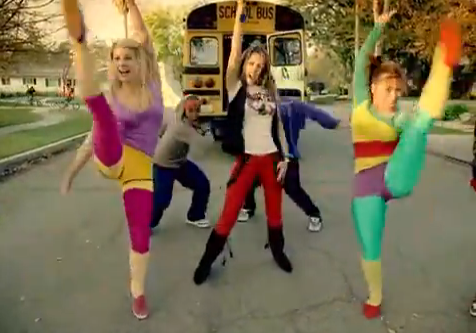
The purpose of the artists image is to promote the artist in a certain fashion and allow the artist to be relatable and to build a relationship with the audience. Artists are constantly changing their image in order to put themselves in the media and to please their ageing target audience. By doing this they are also able to attract different audiences, consequently widening their fan base. Stars such as Miley Cyrus, Rihanna and Britney Spears are popular for constantly changing their style and sound.
For our music video we want to give the artist an edge. Inspired by 90's grunge, we would like the artist to look rough and rebellious instead for steering towards the predictable Nina Nesbitt indie-pop fashion. The reason for this decision is to move away from the artist that we've chosen and break the stereotypical conventions of indie-pop, therefore giving an original feel to our video.
Within our music video I (playing the artist) will be wearing different outfits consisting of garments such as flannel shirts and leather jackets (inspired from the image on the left). Clothing such as ripped jeans, bandanas and doctor marten boots will be worn to give off a rebellious vibe - conventional to our 'grunge' take on the song.
To the right is the outfit that I wore during the performance section. As you can see this outfit is inspired by the picture above, having red tartan, denim and leather jackets in common. I decided to wear an oversized jacket because Drew is seen wearing a lot of oversized clothes. This shows that my portrayal of the artist is still in love with Drew and is trying to find ways to remember him.
The hairstyle was inspired by Rihanna's "We Found Love" hairstyle as we felt that this was an edgy and unique hairstyle and isn't expected within the indie genre. Therefore by using a grungy hairstyle similar to this then we would be able to challenge and break the conventions of the indie genre.
I want Drew and I to wear similar outfits in order to show our 'bond'. I feel that by wearing similar clothes, we will display to audiences our characters affection for each other and their inseparability. For example we could both wear a lot of denim, tartan and leather. This also adds to the grungy style that we are trying to portray. It would be affective if we both wore doctor martens throughout the video, as this would again emphasise our inseparability. We feel that this would contribute to the meaning of the song and the narrative, therefore relating to indie.
In the bedroom scene I think that it would be a good idea to wear the shirt that Drew wore in camden (previously in the music video), the dark blue flannel shirt. This will show how the artist is infatuated by Drew and wants to wear his clothes to feel closer to him. Finally, for my final outfit, I want to wear something very plain to portray the artist's drain of emotion. Perhaps an oversized coat (again similar to Drew's style), a white top and distressed jeans ripped at the knees. The distress of the jeans will represent the artist's frustration and heartbreak. I feel it would be appropriate to let my hair down and messy in order to show how the artist doesn't care about anything except for the loss of her boyfriend. This adds to the emotion of the song which therefore relates to indie in the sense that it's promoting the music.
The purpose of cinematography is to show the audience different point of views and angles throughout the music video. Camera angles, positioning and movement can display locations, iconography and the posture, expression and image of the artist. A wide variety of cinematography is used in order to capture different images and to create a narrative and relationship with the audience in order to make a music video successful.
Here are a selection of camera shots that we will be using:
Example: Mid Shot
We will be using a mid shot to show the use of a guitar within our music video. This will display our use of iconography and the use of instruments will relate to the indie genre. The mid shot will allow the audience to have a clear view of the artist singing and playing guitar and will promote the performance section of our music video. This is conventional to an indie music video as it promotes the music. This would also help the audience build a relationship with the artist as they will understand their musical talent.
Example: High-angled Establishing Shot
We have a particular high angle establishing shots in mind which will show the artist and the boyfriend in the middle of a crowded area with them standing still and everybody else walking around them. This would portray how they are oblivious to everything surrounding them. This therefore emphasises the narrative and the lyrics which is therefore conventional to the indie genre.
Example: Close Up
Finally, we will be using a variety of close ups. For example, here is a close up of Drew underwater. This close up allows the audience to observe Drew's facial expression, which is very blank and emotionless. This shows that he is in such a bad state of mind that he is no longer in control of his body and senses. Rather than having a dramatic death scene we felt that this was more affective as it shows that he is so mislead and unwell that he has lost control. This is conventional to the indie genre as it expresses the emotion of the song and makes the lyrics come to life. The music is therefore being emphasised which is the purpose of the indie genre.
The purpose of setting within a music video is to give the music video an appropriate atmosphere that will relate with the target audience. The location will set the mood and the choice of iconography will bring life to the music video, allowing audiences too see what the artist is experiencing - ultimately allowing audiences to build a bond with the artist. Using specific iconography, such as instruments, will help display the indie genre we are trying to put across as this will be promoting the music rather than the artist. Specific setting and iconography will also relate to specific target audiences. Setting and iconography can also be used to break the stereotypical conventions of the music genre that one is following.
A screenshot of our footage taken in Brick Lane.
We will be including locations such as Brick Lane, Liverpool Street, Camden, a forest. Locations like isolated forests are quite quirky, therefore will relate to indie audiences. We will also be filming sections at Drew's house to display the relationship between the artist and her boyfriend and to show how close they are. We wanted to use more urban locations such as Brick Lane and Camden in order to break the conventions of the indie genre, therefore hopefully making our music video more original. The quirkiness of the city streets will represent the artist, hopefully causing the audience to relate to her and the music video.
In contrast to the urban locations, we will be using a deserted forest throughout the performance sections. Forests are quite quirky, but are also very naturalistic which definitely relates to the indie genre. The emptiness of the forest will imply how empty, lonely and heartbroken the artist is feeling after the loss of her boyfriend. This will add to the emotion and meaning of the song which will consequently promote the music - which is one of the main purposes of the indie genre.
We will be using iconography such as drugs and alcohol in order to show how the addiction is taking over the boyfriend's mentality and body. This will add to the impact of the storyline. However the main piece of iconography that we will be using is a guitar. The use of a guitar will display the musical ability of the artist and will promote her as a singer/songwriter rather than an image. Indie artists tend to use instruments within their music videos for the same reason - because they would rather be sold for their talent rather than their image. Therefore our use of a guitar is conventional to the indie genre and will relate to indie audiences.
Setting and iconography is therefore very important to consider when planning a music video. The micro elements drastically contribute to the visuals of the music video, giving it a certain atmosphere and allowing it to either follow or challenge your chosen music genre. This will ultimately relate to your chosen target audience.
The point of a target audience is to give an advertised product a purpose and to make it presentable and understandable. This is achieved by the artist of the product following particular codes and conventions throughout their work which relate to a specific target audience. We carried out types of research such as questionnaires and vox pops so that we could gain opinions from people that vary in their taste in music in order to gain non-biased results. We surveyed 40 people with our questionnaires and 5 people with our vox pops. We surveyed such a large number, again, to gain a large variety of fair results.
I think that our vox pops were very successful as we surveyed 5 people who varied vastly in age. It allowed us to understand what genre of music the older and younger generations prefer which will consequently help us understand what our target audience should be for our music video. One of the key questions that we included in our vox pops was 'Do you prefer a fast paced or low paced music video?' The majority of people said that they preferred a fast pace music video therefore we have decided that we will include fast pace editing styles throughout our music video. This has backed up our idea of displaying memories between the artist and her boyfriend, perhaps we will shorten and edit these memory clips to play quickly and in fast motion in order to suit the audience's preferred pace. Another key question that we asked was 'Do you prefer a performance based or a narrative based music video?' Most people said that they prefer a narrative based music video as they like a music video to have a meaning behind it. From this we have learnt that it would be appropriate to include more narrative based footage than performance based footage.
We also researched into subcultures. Subcultures within the music industry are demonstrated by people who position themselves outside of the mainstream and unite through a common value system, taste and neophyte. These subcultural gangs hold value in conformity and rebellion and have an attitude towards capitalism. Grant McCracken is a media theorist who believes that the post modern world within the music industry is filled with diverse creativity and that there are so many new ideologies that it is impossible that all subcultures come from one culture. The CCCS however, disregard McCracken's theory and says that all subcultures come from one culture and are a rebellious creation against the mainstream. Finally, Hedbige's belief reflects on both McCracken's and the CCCS's, as he states that deep down all subcultures are the same (a rebellious creation against the mainstream), therefore he refers to them as 'little cultures'.
In conclusion, our research task has been extremely useful and valuable. By researching into subcultures, we believe that our music video follows the theory of Grant McCracken. We have chosen this since our music video is not influenced by the rebellion against the mainstream, however it does consist of new ideologies and individual elements that don't follow the mainstream pop genre.
Here are our results presented as pie charts.We felt that by doing this we would be able to compare, evaluate and understand our results more accurately:
When researching into target audiences and their opinions on a certain product, it is wise to produce a questionnaire as you will gather a variety of answers in which you can compare and evaluate. When presenting questionnaires, it is useful to share you questionnaire with a vast amount of people who vary in age, gender and characteristics. This is so that you are guaranteed non-biased results. Below is a copy of a questionnaire that we created in order to research into our potential target audience. We handed this questionnaire out to 40 people to answer:
'Stars' are constantly changing their sound and image over time to please their target audience. According to Dyer, the term 'star' refers to a mthological set of meanings that are used to construct and sell a performer to an audience. The common values of a star include:
Youthfulness
Rebellion
Sexual
magnetism
Originality
Creative/talent
Aggression
Success
against the odds
Disregard
for social values such as drugs and sex
Conspicuous consumption of sex, drugs and material
goods
Dyer's theory is based upon two paradoxes, which supports his belief that stars are 'incomplete'. Firstly, that stars must be simultaneously ordinary and extraordinary - an ordinary person with and extraordinary talent, causing the person to become extraordinary. Secondly, that the star must be simultaneously absent and present. Absent in the press as the artist takes a break in order to produce more music, and present through the release and promotion of the artist's album/single and through performing.
Miley Cyrus 2007
Miley Cyrus 2012
Artists are constantly updating their image and music in order to set trends and please their ageing audience/attract different audiences to widen their fan base. The artist who I have chosen to focus on, who is constantly and drastically changing her image is Miley Cyrus.Miley Cyrus found her fame playing the lead in the Disney Channel serious 'Hannah Montana'. After playing a singing sensation in 'Hannah Montana', she soon started up her singing career and became a role model for young female teenagers and a teen pop princess. Being such a young age herself, her music videos were aimed at a much younger audience. However, over the years, Cyrus has been proven to constantly change her image in order to please older audiences, attract a wider fan base, and to break away from the 'Disney Channel' image. Here is one of the first music videos that she released to launch her music career:
MILEY CYRUS - 'START ALL OVER'
In 2007, Miley Cyrus originally promoted a rock sound in her music and followed rock/pop conventions within her music videos. 'Start all Over' follows an alternative rock genre with its strong drum beat and electric guitar riffs. She displays a stereotypical rock image, wearing black clothing and red skinny jeans. The music video connotes how crazy Miley's life has become by displaying many 'random' events within the narrative. The music video starts with Miley going to bed, representing the end of a day and the 'starting all over' of a new one. One of Goodwin's paradox's (relationship between the visuals and the lyrics) is used within this music video. During the second chorus as Miley sings "out of the fire and into the fire again" a video clip is presented of Miley dancing with an enormous fire in the background. The use of fire also helps portray her rock image as it is stereotypically conventional to a heavy metal or rock genre. Simultaneously, Miley is presented as a light-hearted pop performer through the use of dancing. Along with other dancers, Miley is shown performing a dance routine, displaying to her audiences that she is fun and is talented within dance as well as singing. This would relate to younger audiences, particularly female, as they would look up to Cyrus and her talent/likability and aspire to be like her.
Towards the end of the music video a performance section is displayed of Miley performing with a rock band. This follows another Goodwin paradox - the relationship between the visuals and the music. The instruments that are shown being played are also heard in the song. The instruments also present Miley as a rock artist. Within this music video, Miley follows Dyer's Theory and presents some of the common values of a star, such as youthfulness, originality and creativity/talent. She also displays Dyer's paradox that an artist must be simultaneously ordinary and extraordinary as she is presented as a very natural and ordinary teenage girl within the music video, however has extraordinary talents and is experiencing extraordinary situations.
MILEY CYRUS - "CAN'T BE TAMED"
'Can't be Tamed' was the music video that demonstrated a drastic change in Miley Cyrus's image and sound. Unlike the previous music video, 'Can't be Tamed' presents darker colours and low-key lighting. Many of Goodwin's beliefs are displayed within this music video also, such as showing a relationship between the visuals and the lyrics and music, voyeurism, and following a performance-based structure. The visuals/narrative throughout the music video clearly display the message of the song 'Can't be Tamed'. Iconography such as a giant birdcage is used to contain Miley, however when she breaks out and dances through the corridors, it is evident that she 'can't be tamed' and is presented as rebellious, dominant and independent. Voyeuristic treatments are used to present Miley in a revealing black leather leotard which proves Dyer's theory that she has certainly altered her image. Cyrus's fashion within this music video becomes a lot more provocative in order to attract older audiences, particularly male. The artist is represented as an admirable model for young women as well as a sex symbol for men.
Dyer's theory is evident within this music video as Miley Cyrus shows more common values of a star. She presents a strong mixture of youthfulness, rebellion, sexual magnetism, originality, creativity/talent and aggression. However, she is displayed wearing giant, black, feathered wings, portraying a bird-like creature and is therefore presented as much more of an extraordinary artist than she was previously through her clothing, originality and body language.
MILEY CYRUS - 'WE CAN'T STOP'
'We Can't Stop' is one of Miley Cyrus's latest music videos promoting her latest change in music and image. Unlike Miley's previous songs, 'We Can't Stop' has many references to drugs and sex, for example "got somebody here, I might get some now" and "trying to get a line in the bathroom". Much like 'Can't Be Tamed', Miley is continuously aiming to please older audiences in order to break free from her childhood image and widen her fan base. Cyrus promotes her new look within this music video, display her cropped blonde and her more edgy fashion sense. In 'We Can't Stop' Miley wears a lot of white clothing, maybe to connote her new artistry and to show that she has broken free from her childhood image. She uses voyeurism to attract attention - by wearing revealing clothing she informs the audience that she has grown up and is rebelling from her past. The visuals obviously match the lyrics as the music video shows Miley partying and having a good time (displaying her youthfulness), however to appear to create a sexual magnetism and appeal to male audiences as much as female, Cyrus appears to flaunt herself provocatively, a feature that clearly contrasts with her first music video. In relation to Dyer's theory, Miley's body language and clothing displays a lot of sexual magnetism, more so than 'Can't Be Tamed' or 'Start All Over', therefore creates a lot of hype and widens her fan base.
'We Can't Stop' definitely follows Dyer's 'Star Theory'. Most of the common values of star (youthfulness, rebellion, sexual magnetism, originality, creativity/talent, aggression, and references to drugs and sex) are evident within her latest music video, which has increased since her first music video. Miley also displays how she is simultaneously ordinary and extraordinary, as she displays an ordinary persona however has extraordinary creativity within her music and music video. With the release of her music video, she has also been simultaneously present through the media and public performances.
For the 2013 VMA's, Miley Cyrus performed 'We Can't Stop' whilst wearing a nude coloured bra and bottoms and dancing provocatively around Robin Thicke. Relating to Dyer's theory, the youthfulness, sexual magnetism and rebellion within this performance was used to create hype and put Miley's name in the media, therefore promoting herself as a product because of her outrageous performance. After attracting so much attention, this performance was guaranteed to promote Miley and widen her fan base.
The reason for Miley's drastic change in image, music, videography and behaviour is to break free and rebel against the 'Disney Channel' label that she developed after finding fame on Hannah Montana, and instead be a successful singer and performer. Using Dyer's theory she has been able to do so. For better or for worse is an indecisive question for audiences, however, over the past few years Miley Cyrus has definitely attracted a lot of attention and has managed to attract different audiences and widen her fan base.

 To the right is the outfit that I wore during the performance section. As you can see this outfit is inspired by the picture above, having red tartan, denim and leather jackets in common. I decided to wear an oversized jacket because Drew is seen wearing a lot of oversized clothes. This shows that my portrayal of the artist is still in love with Drew and is trying to find ways to remember him.

 I want Drew and I to wear similar outfits in order to show our 'bond'. I feel that by wearing similar clothes, we will display to audiences our characters affection for each other and their inseparability. For example we could both wear a lot of denim, tartan and leather. This also adds to the grungy style that we are trying to portray. It would be affective if we both wore doctor martens throughout the video, as this would again emphasise our inseparability. We feel that this would contribute to the meaning of the song and the narrative, therefore relating to indie.